

How to book therapy online
Book Online Therapy today
Take your next step
Start with a free consultation
No referral required.
Get Matched or Choose Your Therapist
01.
Get matched to the next available therapist that meets your needs

You can expect to hear back from us within 48 hours, during regular business hours Monday to Friday.
Please note, we do not offer same-day or crisis services.
02.
Use the filters below to browse our team profiles and book your consultation session directly with your therapist.

Offering a range of fees to meet the needs of our communities.
Fees and Rates
NEW!
Many of our team members offer Direct Billing to your third party insurance benefit plans. Ask your therapist if they are set up.
Psychotherapy & Counselling
All session fees are transparently listed on team individual profiles, as well as on the appointment booking page.
You can click on any therapists photo from our Find a Therapist page to read their in-depth profiles, find fees and current availability.
Or click through the tabs below to see the wide range of fees we offer to help meet the needs of our community.
$100 – 230/per session for Individuals with Registered Psychotherapists, counsellors, or our Occupational Therapist
Our fees for individual psychotherapy, OT or psychologist-supervised sessions range from $100 (our Low-Cost, Supervised Graduate Intern clinic), to $225.00.
$230 for Psychologist supervised sessions – Individuals
These sessions are provided and supervised by our Supervising Psychologist and performed by an RP team member.
$140 – 250/per session for Couples with Registered Psychotherapists
Our fees for couple psychotherapy or coaching sessions range from $140 (our Low-Cost, Supervised Graduate Intern clinic), to $250.00.
$250 for Psychologist supervised sessions – Couples
These sessions are provided and supervised by our Supervising Psychologist and performed by an RP team member.
$140 – 250/per session for Parents and Family sessions
Our fees for Parent counselling, Parent Coaching, or Family Therapy sessions range from $140 (our Low-Cost, Supervised Graduate Intern clinic), to $250.00.
$250 for Psychologist supervised sessions – Family
These sessions are provided and supervised by our Supervising Psychologist and performed by an RP team member.
Groups are a proven way to experience the benefits of a facilitated, structured and therapeutic setting, while being very cost effective per session.
Check out our EVENTS page to see if any of our current offerings are a good fit.
Wondering if we can do Direct Billing?
- Check to see if your insurer is listed here: Telus eClaims Insurer Chart.
- Provide your insurance plan and certificate number to your therapist to see if your plan is eligible!
Many therapists on our team offer sliding scale spots that might temporarily reduce the burden of longer-term treatment.
Please ask your therapist about their current availability of sliding scale rates and how to access reduced fee sessions should you require them.
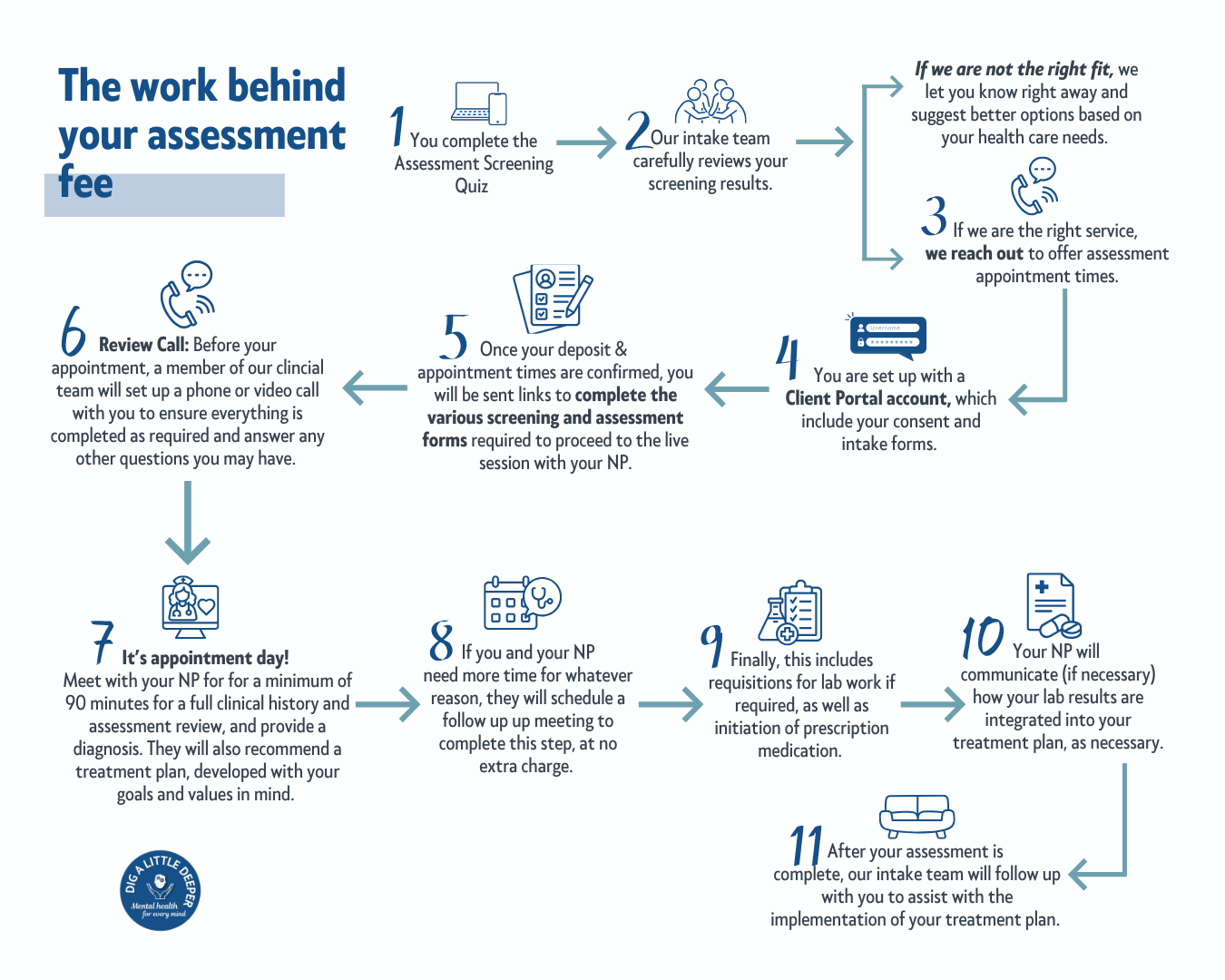
rates for Integrated Mental Health - NP Services
Comprehensive mental health assessment, diagnosis or diagnostic clarification, and initial treatment.
- Adults (17 and up) $800.00 (90 – 120 minutes)
- Pediatric (age 10 – 16 yrs) $ 800.00 (120 minutes, includes family interviews)
Included at no additional charge:
Confirmation of diagnosis and prescription recommendations.
Learn more about the work covered in this assessment rate.
A Mini-Psych Evaluation is for individuals who have had a psychological or psychiatric evaluation within the previous five years, and are seeking a follow-up psychiatric assessment, instead of a full, in-depth evaluation
- Adults (17 and up) $450.00
Learn more about the work covered in this assessment rate.
You can chose this service if you have a confirmed psychiatric diagnosis and would like to review and adjust your treatment plan only for medication management.
- You must submit a recent psychological or psychiatric report confirming your diagnosis to receive this type of appointment.
- The NP will review the report prior to meeting with you. If you have more than one mental health diagnosis and the NP requires a more thorough assessment to confirm diagnosis, you may require a psychiatric re-evaluation.
$375.00 (60 min)
Additional fees apply for in-depth reports:
- In-depth treatment plan reports, or case summaries for transfer of files,
- Workers Compensation reports,
- Long Term Disability Insurance reports,
- Academic institutions reports and forms.
Please visit our FAQ page for a full listing of all report rates.
If you stay on with your NP to manage ongoing treatment, follow up appointments are necessary to monitor treatment effects and to renew your prescriptions ethically and responsibly.
For ongoing medications/prescription refill appointments:
- $100.00 (20 minutes)
Routine repeat prescriptions in between visits:
$25.00
Missed appointments:
$60.00
Low Cost Clinic
If you’ve been thinking about trying therapy but don’t have health benefits, you’re not alone, and you’re not out of options.
We offer affordable, reduced-rate counselling to help make support more accessible, no matter your financial situation. Everyone deserves a place to feel heard.
We fully supervise our Graduate Counselling Interns completing their training for full licensing (Essentially 2 therapists for less than the cost of one, and contribute to the education of future therapists! )
These sessions are $100, and there are some sliding scale spots available.
Interns offer both virtual and in-person sessions (Bolton), across Ontario.

Secure messaging
Log in to your account to send a Secure Message to your Therapist or Nurse Practitioner.

Book your appointment
Log in to your account to manage your appointments, view or download your receipts or message your therapist.

New client intake
If you are a new client, you can fill out our confidential Intake Form, to be matched with the next available therapist that meets your needs.
Appointment Confirmations and Reminders can be customized to the timing intervals that work for YOU, within your Client Portal account.
To ensure you don’t miss these notification’s, please add us to your contact list.
Common Therapy FAQ's
At the first psychotherapy session, the therapist usually gathers information about you and your needs. You may be asked to fill out forms about your physical and emotional health. It might take a few sessions for your therapist to fully understand your situation and concerns and determine the best course of action.
The first session is also an opportunity for you to get to know your therapist. You’ll be able to see whether the therapist’s approach and personality are going to work for you. Make sure you ask about and understand:
- What type of therapy will be used,
- The goals of your treatment,
- How long each session will be,
- How many therapy sessions you may need.
Ask questions anytime during your appointment. If you don’t feel comfortable with the first therapist you see, try someone else. Having a good fit with your therapist is critical for effective treatment.
Missed sessions must be paid for by the client. Insurance providers rarely pay late cancel or no-show fees.
Most often, people see a therapist once a week, or bi-weekly. But it can be more or less frequent than this. It depends what you agree with your therapist and how they work.
A typical session is 1 hour long – consisting of 50 minutes talk-therapy with client and therapist, and 10 minutes note taking plus administrative issues.
- According to the American Psychological Association, around half of people who take therapy will experience a benefit to their mental health after 15 to 20 sessions. Many people will continue therapy long after they experience these benefits because these benefits can grow over time.
- There are a growing number of specific psychological treatments of moderate duration (e.g., 12 to 16 weekly sessions) that have been scientifically shown to result in clinically significant improvements.
- In practice, patients and therapists sometimes prefer to continue treatment over longer periods (e.g., 20 to 30 sessions over six months), to achieve more complete symptom remission and to feel confident in the skills needed to maintain treatment gains.
- Clinical research evidence suggests that people with co-occurring conditions or certain personality difficulties may require longer treatment (e.g., 12-18 months) for therapy to be effective. There are a few individuals with chronic problems who may require extensive treatment support (e.g., maintenance therapy to reduce risk of psychiatric re-hospitalization), but such patients are a minority of those who need or seek treatment.
Your therapist is your therapist. ‘Dual relationships’ exist when a therapist or clinician interacts with you in any capacity beyond their role as your therapist or clinician, (for example, conducting unrelated business, or perhaps you might be the teacher to their child). This is a separate issue from couple or family therapy, but specific to treating individual members of the same family (as one example). This could lead to a situation where the therapist cannot promote the interest of one client without adversely affecting the interest of the other client. This is a conflict of interest.
Not all dual relationships are avoidable, or unethical. In those circumstances, the therapist must use their professional judgment, and ensure that safeguards for clients are in place, (e.g., appropriate supervision/consultation, ensuring that any conflict-of-interest concerns are addressed, etc.). In a small or isolated community, one therapist may be the only person who can provide psychotherapy services, or a niche are of specialization, to local residents. As a result, the therapist may provide psychotherapy to someone who is also their mechanic, hairdresser, lawyer, doctor, etc. It is always the responsibility of the therapist to being aware of, and avoid, situations that may place them in a conflict-of interest, which might mean making a referral to the next available therapist.
Our regulatory College advises it’s generally best to avoid this situation wherever possible, though in some circumstances doing so may be difficult (including if the connection between clients is discovered after therapy has begun, or if it would be difficult for the potential client find treatment elsewhere.
The way psychotherapists and counsellors work can overlap. Both use talking therapy to help someone tackle an emotional difficulty. But the training for each is different.
Psychologists, psychiatric nurse practitioners and psychiatrists are different. Psychiatrists are medical doctors that diagnose illness, prescribe medication, manage treatment and provide a range of therapies for serious mental illness. Psychiatric nurse practitioners also diagnose illness, prescribe medication, manage treatment and very often provide counselling in specific areas of therapeutic specialization.
Psychologists can specialize in all sorts of areas. These include school and applied psychology practice, clinical practice, forensic work and child and adolescent interventions. Like Psychotherapists, it is important to note that psychologists are not medical doctors or nurse practitioners, and they cannot prescribe medication.
A psychotherapist may also be a psychiatrist, psychologist, or other mental health professional who has done additional training in psychotherapy.
We absolutely hope you feel comfortable to ask for what you need (and sometimes that’s exactly the work). Sometimes it’s as simple as needing more time to process or think about a question before answering, or sharing that the way they are asking a question isn’t how your brain processes, is very helpful information to share with your therapist. If something isn’t working for you, or if something would help you, a large part of your therapists’ job is to ‘meet’ you there.
If you are neurodivergent and looking for some of the specific things you and your therapist can adapt to make therapy work better for you, check out our article on this topic called Neurodivergent-Affirming Clinical Practices and Psychological Safety.
It is important that your therapist is empathic, caring, and affirming, that you feel fully seen and understood, and that you and your therapist are on the same page regarding treatment goals and how you will work together to achieve them. The most common overarching goal of therapy is to facilitate positive change, in alignment with your values, strengths and goals, to improve your feelings of satisfaction and the overall quality of life.
Check out our list of things to consider if you are wondering whether you are ready for therapy HERE.
Confidentiality is considered a cornerstone of the profession of psychotherapy and is embedded in its core values. All information shared in a therapy session is held confidential and will not be shared with a third party without your knowledge and written permission – except where required by law. These requirements are referred to as ‘limits to confidentiality ‘Limits to confidentiality’ include the following:
- If you threaten imminent and serious physical harm to yourself;
- If you threaten serious physical harm to someone else;
- If you report physical, emotional, sexual child abuse or neglect of a person under the age of 16 (even if the person is an adult now) if there is reason to believe the accused abuser is in a position to abuse other children;
- If you report you have been sexually abused by any health care professional;
- If your file is subpoenaed by a court order.
- The Missing Persons Act enables police to make an “urgent demand for records” where the “missing person” has not been in contact with people they would expect to have been in contact with and there are reasonable grounds to believe their safety is at risk.
Our client portal is encrypted, has servers exclusively located in Canada (Toronto and Montreal), and access to the system is granted only on an as-needed basis and governed by our strict confidentiality policy. Additionally, all practice data in the system is routinely backed up to ensure the privacy and protection of sensitive client information and to assist us with PHIPA compliance. If your sessions are online/video, our practice uses a secure telemedicine platform, which meets all regulatory requirements for privacy and security in Canada (HIPPA, GDPR, PHIPA/PIPEDA).
It is free to use this platform, and no downloads are required.
Psychotherapy services outside of hospitals, or public agencies, are generally not covered by OHIP, including assessment and treatment within our Nurse Practitioner clinic.
If you have health benefits through your employer, your benefits likely offer some or complete coverage for psychotherapy through a private practitioner.
Many of our therapists do offer rates at a sliding scale based on your income. Learn more about insurance reimbursement and our rates HERE.
Post-secondary students who are opted in (or didn’t opt out) to their university or college health insurance plan do have coverage for private mental health care services.
This means they have coverage to see therapists or counsellors in their community who do not have wait lists and specialize in areas they are looking to address!
- The Canadian Life and Health Insurance Association estimates that 67% of Canadians have extended health care benefits through their workplace, privately held insurance, or through a government support program.
- If you do not have insurance, our licensed therapists are authorized medical practitioners in Ontario as recognized by the CRA and services are deductible under your medical expenses for your annual tax return. To learn more about this option on the CRA website, click here.
- Many extended health benefits insurance providers do cover psychotherapy services, partially or in full.
- It is up to the client to know if your insurance plan covers therapists with your clinician’s professional designation. Not every insurer covers every type of mental health therapist. Which type of clinician is allowed to direct bill is entirely at the discretion of the insurance provider and/or employer.
- We are registered providers for many plans, including plans with Sunlife, WSIB, Manulife, Great West Life, Medavie Blue Cross, Greenshield, Equitable Life, Aspiria & the Ministry of the Attorney General Victims and Vulnerable Persons Division Victim Quick Response Program+. To ensure you can have your session reimbursed, you should always call your plan to ask in advance.
- To know for sure whether you can claim your sessions, you must first confirm with your insurance provider your annual limits/caps and exclusions (everyone’s plan is different, and plans are set by employers). We are not responsible for the outcome of your claims.
Specific members of our team do work with WSIB, HCAI, LTD insurance claims. Please inquire directly with your therapist about these options.
In consultation and collaboration with a Clinical Psychologist, we offer mental health services / psychotherapy through the WSIB Community Mental Health Program. These services are available online and in-person at our Bolton location to those with a registered WSIB claim in the Community Mental Health Program. To learn more about submitting a work-related mental stress injury claim, please contact WSIB (https://www.wsib.ca/en/injured-or-ill-people/claims/work-related-mental-stress-injuries).
Clinician referral forms
Physicians, Nurse Practitioners, Psychologists or Psychotherapists who would like to refer patients directly to us with additional documentation may use the following:
Click to download and fax the fillable PDF below, to fax: 1-833-479-0186.
